I feel like our economy has been driven by mass production for so long that we’ve forgotten just how intensely time-consuming making things by hand is. Mass production was revolutionary for a reason. It DRASTICALLY reduced the cost of things. And I’m all for making things more affordable! But the problem arises when people decide they want something handmade for the cost of something mass produced. People get an idea in their mind “this is how much x item should cost” when in actuality that’s how much a machine made version of that thing costs. Then they hear the price of something made entirely by hand and think “that person is ripping me off.” If you want something handmade, you have to compensate the person making it fairly.
This applies to repair and restoration, as well. If your Gramma’s handmade quilt needs a few threadbare squares replaced, or the binding mended, that’s going to take time, to A. find period appropriate fabric in colors that go with the ones used in the piece, B. Fit the patch into place using hand stitches that match the rest of the ones in the quilt, both in tension and in length, and C. finish off the repair invisibly, from the right side of the fabric rather than from the underside, as it was originally constructed.
This is all fiddly hand-work. It takes knowledge, some experience, dexterity, patience, and work. If you want it done well, expect to pay for the expertise.
remember in goblet of fire when minerva says ‘potter’s a boy, not a piece of meat!’
imagine harry telling her everything after the battle of hogwarts, telling her about how dumbledore raised him like a pig for slaughter, and how he had to die and mcgonagall gets so goddamned mad
she loses control for the first time that harry’s EVER seen and she’s actually yelling, she’s so pissed that harry was seventeen and he had to accept death and dumbledore KNEW he would have to die and NEVER TOLD HIM
and harry’s about to cry because yeah his friends would be devastated if he was gone but NO ONE got this damn pissed that dumbledore had raised him so that he could die at the right time and mcgonagall’s in the middle of a rant and he just shoots up and hugs her and she’s stunned into silence but after a moment she hugs back and it’s great
and then she goes up to her office and starts screaming at dumbledore’s portrait because ‘i don’t care if it had to happen, albus, he is a CHILD-’
speaking as a Jew, i’m extra-super dubious of all that stuff that talks about cartoon witches being an antisemitic stereotype. I can get where the thing with the nose is coming from, but the claims about the hats are based on flimsy claims that require a lot of mental reaching. The hats that Jews were forced to wear were not a universal thing, and I’ve yet to see any evidence that they were part of the cultural consciousness by the time the image of the pointy-hatted witch became common.
The biggest points against the hat hypothesis:
Wrong time period: witch hats as we know them seem to have only started appearing in art around the 17th-18th century; in the period when the Judenhut was well-established, witches in art just wore whatever was common for women of the region.
Wrong region: the pointed witch hat originated in English art, as far as i’ve seen. Antisemitic laws in England mandated badges, not headwear.
Wrong gender: Jewish hats were mandated for men, not women—illustrations of witches with pointed hats very rarely included male witches, until fairly recently.
Wrong shape: there are many styles of mandated Jewish hat throughout history, but few of them are even a near match for the very specific look of the Witch hat.
You know what kind of hat does closely fit?
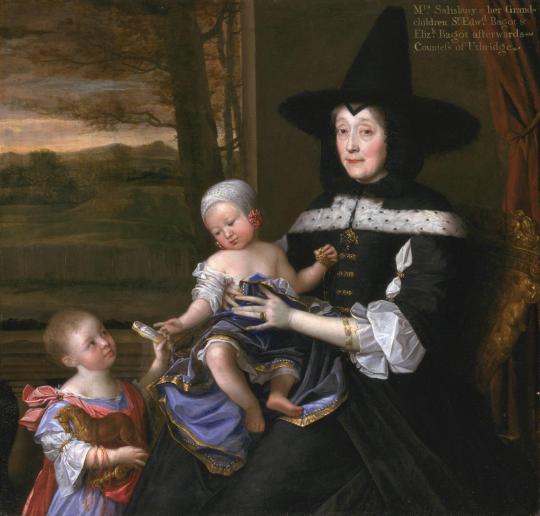
The hat in this painting (“Portrait of Mrs Salesbury with her Grandchildren Edward and Elizabeth Bagot” by J.M. Wright; circa 1675) was “a type worn by affluent women throughout Britain at this date”. Look at that hat. Any modern viewer looking at this painting might think it was supposed to be a character created by J.K. Rowling.
It’s a match in design, gender, region, and most importantly, time period: by the time that pointed witch hats started to appear in artwork in England and English colonies, this style of hat would have been associated in the cultural consciousness with elderly women, especially those who were clinging to decades-old fashions.
The easy, simple answer to where the witch hat came from: it’s exactly what a woman with all the stereotypical qualities of a witch would have worn in the first place, in the time and place the trope originated.
Old-fashioned but not by several centuries, severe and somber, and popular with a class of women that people would have spread nasty rumors about in the first place (somany accusations of witchcraft were directed specifically at women who were independently well-off, whether out of simple envy or else scheming).
Seemed like about time to bring this back up.
Another very obvious and often explicitly stated basis for the CLOTHING of the cartoon witch is Puritan costume from the 18th century… seeing as Puritans were famous for their witch trials.
The green skin, curly hair, big nose, warts etc are all definitely at least racialized things. Though big nose and warts are associated with age the combined picture is pretty much just a racial caricature.
Important input on the witchy costume debate, from a Jewish person who’s clearly done a bit of homework on the origins of pointy hats and green makeup. (And who also seems to be a pretty cool person into the bargain.)
I’ve reblogged this before, but it’s got new info, which is great
I’d also argue that, though certain aspects of the stereotypical witch align with antisemitic tropes, it’s far more likely that witches’ stereotypical looks actually emerged by being the polar opposite of what the beautiful, and therefore ideal, 17th century woman looked like. This was to emphasize that a witch was the OPPOSITE of an ideal woman, and she could thus be placed in opposition to the beautiful, ideal heroine.
Where beauty (according to 17th century standards) was young, witches were old. Where beauty had fine, delicate features, witches had exaggerated, rough features. Where beauty was relatively unmarred (a rarity in pre-vaccination days), witches had moles and other marks. Where beauty had silky blonde hair (a treasured prize in Renaissance times, to the point that women falsely lightened their hair or wore wigs), witches had rough black hair.
As I said, some of these line up with antisemitic tropes. However, I’d argue that associating Jews with these tropes was a result of already-established patriarchal beauty tropes that had been ingrained in northern Europe for centuries. The fact that the stereotypical Jewish woman happened to defy the beauty ideals of northern Europe was used as an excuse to further oppress Jewish people, not the other way around.
In other words, I’d guess that it went like this:
“Ugliness/evil looks like this” -> “Some Jewish women (who we hate) look like this” -> “here’s proof that Jewish women are ugly and evil”
Rather than:
“Jewish women look like this” -> “we hate Jewish people” -> “Ugliness and evil looks like this”
Of course, once both tropes (ugly witches, ugly Jews) were established, I imagine that they fed into one another, but I’m dubious of the claim that the source of the ugly witch was the Jewish woman, especially since northern European ideas of beauty and fears of malevolent witches seem to go back further than northern European stereotypes of the ugly Jewish woman.
Augh, and COMPLETELY forgot to talk about this, but the stereotypical witch outfit? It comes from traditional English brewsters/alewives, aka, female beer-brewers.
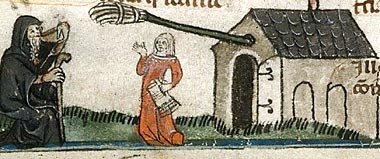
Who used brooms mounted above the door as a way to signal their trade to passerby:
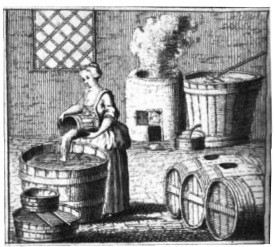
And who made their trade making strange concoctions in cauldrons:
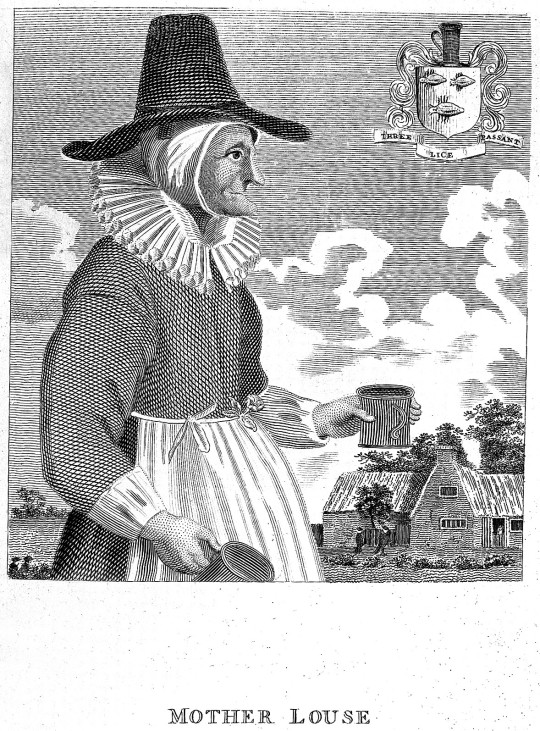
And who happened to wear hats just like this:
Brewsters/alewives used to have a monopoly on beer-making. They handed down brewing secrets from mother to daughter and basically controlled the alcohol market. And men weren’t terribly keen on that – they wanted in on this immensely lucrative, influential field. There were some male brewsters, but the trade was overwhelmingly female, to the point that even male brewsters were still called brewsters – a female noun.
So what do men do when they want to push women out of a trade? They demonise them.
Suddenly the broom isn’t just a business sign, it’s a tool for going to meet the devil. The cauldron isn’t just a tool, it’s a place to create evil. The hat isn’t just a trade uniform, it’s a mark of malevolent intent and arcane knowledge.
Coincidentally, many women who became brewsters/alewives became independently wealthy and quite powerful locally. They didn’t need to marry and could provide for their entire households with their trade. They could grow old without marrying, or they could stay unmarried after their first husband dies rather than remarrying. They could also pull strings and influence things in their favour, making local politics ‘mysteriously’ go their way.
And so the stereotype of the ugly spinster brewster-witch is born.
And, as I’ve said above, ugly women look a certain way: harsh, marred features, dark, tangled hair, and above all, old.
Note old Mother Louse up there. She was a well-respected brewster in her town, with plenty of influence, but here she is already being portrayed with stereotypical witch features: a big, hooked nose, and a pointy chin, hollow eyes, sharp cheekbones (not a good thing in premordern times – beauties had rounder faces, as sharp cheekbones were a sign of hunger or oldness). Mother Louse isn’t being portrayed as Jewish, but as an elderly, ugly spinster, who engages in the lucrative, powerful – but suspect – business of brewing.
Know who else this happened to? Midwives. Another female trade, passed down from woman to woman, dealing in business secrets from which men were barred – and this in regard to the most mysterious power of all: the power to bring life into the world. And midwives do pretty well for themselves, too: plenty of families are willing to pay a bundle to make sure their babies are delivered safe and sound in a world with high infant mortality. Just like male physicians, midwives knew how to create tinctures and mix herbs, but now, once again, rudimentary chemistry and herb-lore become demonised when women are the ones doing it. Now, if your baby is born sick, deformed, or dead, it’s clearly the spinster midwife’s doing, full of spite because she has no children of her own.
Anyway, there’s your witch history for the day. The hooked nose and black hair are already something of a stretch, but the claim that the typical witch hat is somehow linked to anti-semitism and not brewsters is totally ahistorical.
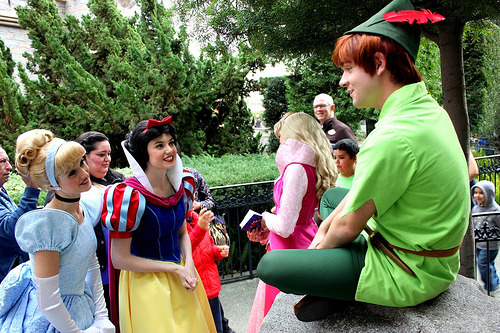
So I went to Disney about a month ago and i got to meet aurora. she asked me and my mom if there were any “princes’” with us today. When I told her that I leaned more toward princesses she looked over at Cinderella sighed and replied with “yeah me too” and I think about that a lot.
God I really wish carrying stuffed animals around with you was socially acceptable
I don’t mean to take over a post, but I actually did a project on this for my sociology of deviance class in college!
I carried a large stuffed rabbit whenever I went in public for about a week to observe the reaction of others. The point of the project was to do something harmless yet unusual to see if the action would be considered deviant, in which case someone had to try to correct or shame the behavior.
Long story short, nobody tried to correct my behavior. I was asked about it casually, had a few lingering stares thrown my way and when I was with my boyfriend, shop employees would direct questions to him instead of me. However, nobody refused to assist me when I was alone in a store, nobody said anything about the rabbit besides “oh, thats a cute bunny!” and I attended college classes without even a teacher questioning it.
In conclusion, it is socially acceptable to carry a stuffed animal, its just not a societal norm. ^^
My friend gave me a stuffed monkey plushy when I was struggling with uni, and I took him everywhere for like four years, usually velcrod to my backpack. No one said a damn thing, except my renaissance professor who saw it one day in the hallway and cracked the fuck up because I had a literal monkey on my back and he just looked at me like, “oh god, me too”. I used to leave him on desks during classes and exams (the monkey, not my prof). It was my reminder that someone cared if I was coping. But more than that it was soothing to have something to fidget with that wasn’t a pen. I used to ping those fucking things across the room I was so agitated. Harder to hurt people with a projectile stuffed monkey.
I got what I thought was a normal screen cleaning kit for my computer while I was in college. Much to my delight, instead of a little washcloth or whatever, the kit came with a tiny stuffed pig.
So I carried this pig in my backpack all through college, periodically taking it out, spraying my screen, and using the pig to wipe it off.
Now, I kept the pig in the side pocket of my bag where he was completely visible.
Then one day in screenwriting class I pulled him out to wipe my screen.
One of the guys sitting next to me looked appalled. “You’re wiping it off with your little stuffed animal??”
I explained what the pig was.
Turns out, the guy had noticed it and just thought it was adorable I carried a stuffed animal with me every day. He’d never mentioned it before.
Honestly, people do not care, and will not say anything. No matter the reason for your little stuffed animal friend.
And if you’re still really nervous about it keep a stuffed animal keychain on your bag. I have a cute little frog that stays on my backpack so when work gets stressful I can squeeze it.
For my anxious followers.
I love this so much. It reminds me that people can just be accepting, and if they aren’t – it’s by their choice. It isn’t a default.
I’ve seen people in college wearing pjs and art students always carry weird atuff. I saw a person in a suit by the math building holding what looked like a keychain with three if those fuzzy ball things in different colours and no one said a word. Bring your plushies and friends with you! Heck, if you have an office job you can bring a friend with you and keep them on your desk and if you work retail you can find a friend on a keychain and keep them on your belt, no one will care and you’re little friend can help you feel better!
Don’t let society bully you into changing. Inagead, lets change society into being accepting.



 Iron in the Sand