geekandmisandry:

robotsandfrippary:

saphire-dance:

iesika:

naamahdarling:

reno-dakota:

auntiewanda:

epoxyconfetti:

codex-fawkes:

unified-multiversal-theory:

stained-glass-rose:

hyggehaven:

profeminist:

Source

I want men to try and imagine going about your day–working, running, hiking, whatever–and not being allowed to wear pants under threats of violence or total social and economic exclusion.

That’s the kind of irrationally violent and controlling behaviour women have been up against.

Also for anyone who thinks it’s easy for women to be gender non conforming because we can wear pants.

The only reason we can is because we fought tooth and nail for the right to! Any rights we take for granted today we’re the result of a prolonged, bitter battle fought by our predecessors for every inch of territory gained. Never forget that.

Title IX (1972) declared that girls could not be required to wear skirts to school.

Women who were United States senators were not allowed to wear trousers on the Senate floor until 1993, after senators Barbara Mikulski and Carol Moseley Braun wore them in protest, which encouraged female staff members to do likewise.

This was never given to us. Women have had to fight just to be able to wear pants. Women who are still alive remember having to wear skirts to school, even in the dead of winter, when it was so cold that just having a layer of tights between them and the elements was downright dangerous. Women who remember not even being allowed to wear pants under their skirts, for no other reason than they were female.

So don’t talk about women wearing pants being gender nonconforming like it’s easy. It’s only less difficult now because your foremothers refused to comply.

My mother spent her entire school career up until high school having to wear skirts, no matter how horrible the New England winters got, because she was forbidden to do otherwise. There were times when the weather was bad where my grandmother kept her home rather than make her walk to and from the bus in a skirt. 

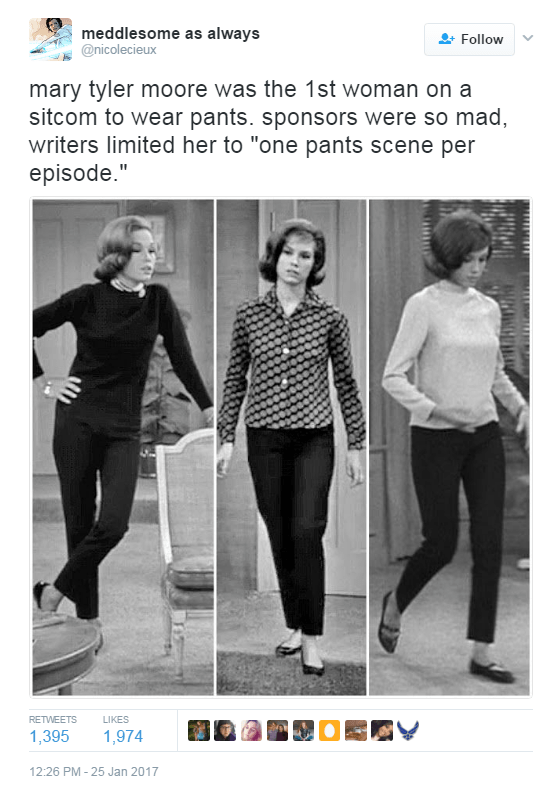
They rebroadcast a few old interviews with Mary Tyler Moore, and in them she addressed the pants issue. There was a strict limit on what kind of pants she could wear (hence, always Capri pants, nothing masculine), and to use her words, how much cupping the pants could show. A censor would look at every outfit when she came out on stage, and if the pants cupped her buttocks too much, defining them rather than hiding them, then she had to get another pair.

A prime example of how gender is socially enforced.

I remember a prolonged battle at primary school, with petitions and numerous near riotous PTA meetings before girls were allowed to wear trousers. In the late 1990s/early 2000s. In Scotland. A country which now (rightly, for the most part) prides itself on its progressiveness. Please don’t ever take these things for granted, and don’t assume that it’s only far flung places that you have nothing in common with that took so long to catch up. We’re all still fighting, little by little, for every apparently trivial victory that mounts up until we can reach the non-trivial ones. And we can’t afford to stop.

At my private Catholic high school, girls were only given the green light to wear pants the year before I began attending.

In 1992.

Yeah, 1991, forced to wear dresses in school. Got detention once because after school was over while waiting for my ride outside I took off the dress that was over my button down shirt and normal-kids-shorts-length shorts because it was Louisiana degrees outside and I was 7.

My mom had to wear a dress to gym class.

https://www.today.com/style/school-s-uniform-doesn-t-allow-girls-wear-pants-so-t141519

We’re still fighting for the right to wear pants.

Teachers were forced to wear skirts for years. And heels.  My mother’s feet are still high heel shaped when she takes off her shoes. She had to wear a skirt till I was well into junior high.

In my primary (elementary) school the girls had to wear dresses. There was a winter and summer dress,, with the winter dress being of thicker material but still, at the end of the day, a dress.

And there were rules about what girls were allowed to wear under them as well. The boys had access to school trousers, like, sweatpants? Trackpants. But we weren’t allowed to wear those under our dress, we could wear stockings or green leggings. That was it.

Honestly the boys were allowed to dress like warm goblins, they didn’t have any rules. But ours was very concerned about looking good. I remember this because it was something I was mad about and I didn’t understand, I was like.. .7 and they wouldn’t let me wear thick pants under my dress because. . . Fashion.

yeahiwasintheshit:

fromacomrade:

cosmomage:

ftwobr2000:

running-batty:

It’s that time of year to say no to the Salvation Army.

Never forget they let a Trans woman die instead of helping her.

Never forget they have tossed entire families on the street for having an LGBT child.

Never forget they tell non Christian families that unless they convert they will not help them.

Never forget that the Salvation Army is bigoted and hateful, many of the bell ringers routinely heckle and harass LGBT couples.

Annual reblog.

In case you’re worried about being rude by ignoring the bell ringers. 

Fuck the Starvation Army. Give them nothing.

NEVER DONATE TO THE SALVATION ARMY

the-moti:

nostalgebraist:

 There’s something a little mysterious to me about the usage of “the” vs. “a/an” in math.  It seems related to a difference which comes up when we’re characterizing mathematical entities through their properties:

  1. Sometimes we want to make statements that apply to every thing that has these properties, even things that also have some other properties we haven’t mentioned (”a/an”)
  2. Sometimes we’re trying to single out an object characterized by these properties and nothing else (”the”)

After thinking about it for a while recently, I get the sense that you can look at a lot of things in either of these ways, and the standard linguistic choice just reflects the perspective that comes more naturally, not some specific type of property that’s shared across every case.  But maybe I just don’t understand this?

The difference between (1) and (2) is that (1) applies after adding properties to an object.  By “properties” I’m actually thinking of two different kinds of things – I’ll call them constraints and structure.

Constraints are extra equations of the same kind as the original characterizing ones.  When you characterize a group by its presentation, you specify the (cardinality of the) underlying set along with some equations relating an element to another  So, for example (thanks Wikipedia), the cyclic group C_8 has presentation < a | a^8 = 1 >.  But this doesn’t just mean that it has one element, a, satisfying the equation a^8=1 – because there are another groups like C_4 and the trivial group that satisfy this equation.  What uniquely identifies C_8 is that it is the “freest” object fitting this description, i.e. the one that doesn’t satisfy any other equations.

Some of the things that can be said about C_8 would be equally true for any group with one generator satisfying a^8 = 1, and we could imagine having a (similar but not identical) description of these things.  We would call these “C_8s” or some other plural noun, we would say things like “a C_8,” and the specific group now called C_8 would be “the free C_8.”  This is the situation for the relations that characterize Abelian groups, for instance.  (The reverse would be to call the free Abelian group “the Abelian group” and call specific Abelian groups “homomorphisms of the Abelian group” or something.)

Structure, as opposed to constraints, means properties of a different kind which are invisible from the perspective of the original characterizing properties.  With a group, you can turn it into a ring by adding another operation, but this is not related to group-level properties (i.e. not relevant for group isomorphism): you can’t look at a group and say whether it’s “currently being a ring operation” rather than “just being itself,” the way you can say whether or not something is the freest group of some description.

The justification for collapsing all objects fitting a description into a single object, worthy of “the,” usually involves some particular isomorphism.  All of the objects satisfying the (absolute) presentation of C_8 are group isomorphic, so from the group perspective, it feels like there’s just this one thing, C_8.  But you can of course exhibit two different versions of C_8 with some extra structure, and don’t have that structure’s isomorphism.  In this way, you can make any one thing plural by adding some extra distinguishing variables.  So “the” is always at risk of turning into “a/an” if you find some companion structure you want to talk about a lot.

Like, why do we say “a vector space of dimension n over R,” rather than “the vector space of dimension n over R,” since they’re all the same thing (isomorphic)?  This was the thought that led me into this – that’s always felt off to me somehow.  And it seems like the reason is that these objects (pretty boring by themselves) are mostly used with extra structure added, so it’s natural to think of there being many different versions of each one.  (This is equally true whether it’s something like an inner product, or something about what the vectors “really are,” e.g. the polynomial vector space P_2 and Euclidean 3-space have the same dimension, but you can evaluate polynomials at points in R, you can’t do that with Euclidean points.)  This is very different from the situation in group theory, where you are thinking of groups abstractly and isomorphism feels like identity.

This perspective also seems to illuminate why I always found descriptions of vector space duality weirdly offputting.  They’re talking about these two “different” vector spaces, but they’re isomorphic, so in pure vector-space-world, what difference could they have?  I guess the answer is, each one of them is actually given some (different) extra structure.  But this extra structure is described entirely in terms of vector spaces and it’s easy to get the sense it is something intrinsic.  (I guess I am saying that once you are talking about V and V*, these objects are no longer quite as generic as pure vector spaces.)

I think your intuition can be made completely precise here. Saying “a vector space of dimension n” and therefore pretending that there are many different vector spaces of dimension n is a hack to help our brains avoid thinking about non-canonical isomorphisms. If you say “Let V be a vector space and let V^v be the dual vector space” then anything you say after will be invariant under the action of GL_n on V. If you consider a vector space R^n, you may view it as both a space and the dual space, and thereby construct something that is only invariant under O(n).

So some mathematicians will believe that we should only say “the” when the object in question is unique up to unique isomorphism.

patchouliandfern:

rohie:

“The low-maintenance woman, the ideal woman, has no appetite. This is not to say that she refuses food, sex, romance, emotional effort; to refuse is petulant, which is ironically more demanding. The woman without appetite politely finishes what’s on her plate, and declines seconds. She is satisfied and satisfiable.

A man’s appetite can be hearty, but a woman with an appetite is always voracious: her hunger always overreaches, because it is not supposed to exist. If she wants food, she is a glutton. If she wants sex, she is a slut. If she wants emotional care-taking, she is a high-maintenance bitch or, worse, an “attention whore”: an amalgam of sex-hunger and care-hunger, greedy not only to be fucked and paid but, most unforgivably of all, to be noticed.”

— Hunger Makes Me, Jess Zimmerman

and that’s the tea folks